


Eight years ago, innovative thought leaders from the provider, payer and vendor communities set aside competitive differences to create the HL7 Da Vinci Project. They focused on discovering how a standards-based approach could address the common data exchange challenges the healthcare industry has faced for decades.
As an HL7 FHIR Accelerator, the HL7 Da Vinci Project is working to accelerate the adoption of HL7® FHIR® as the standard for supporting and integrating value-based care (VBC) data exchange across communities. The Da Vinci Project focuses on minimizing the development and deployment of one-off solutions between partners with a goal to help all clinicians and health plans to better deliver clinical quality, value and care management outcomes. Da Vinci continues to build on the founders’ vision, as demonstrated by the 2025 highlights of its collaborative work featured below.
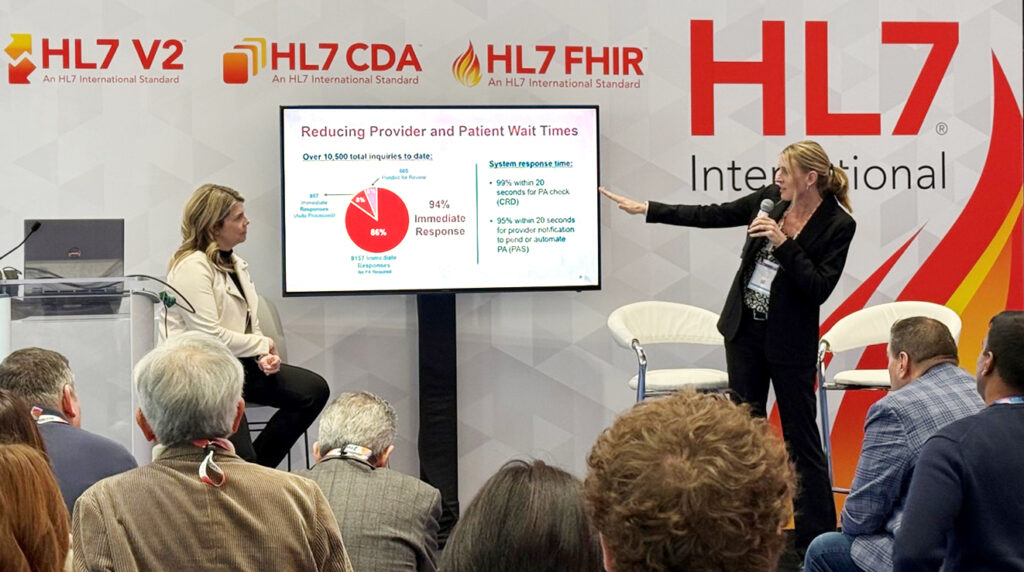
At HIMSS25, trailblazers Anna Taylor of MultiCare Connected Care and Heidi Kriz of Regence shared that when using a standards-based approach 94 percent of prior authorization inquiries received an immediate response and resolution.
Transforming Healthcare Through Governmental Commitment and Continued Regulatory Inclusion of HL7® Fast Healthcare Interoperability Resources (FHIR®) and Da Vinci Implementation Guides (IGs)
Building upon last year’s recognition in federal regulation with the finalization of CMS Interoperability and Prior Authorization Final Rule (CMS-0057-F) and Health Data, Technology, and Interoperability: Certification Program Updates, Algorithm Transparency, and Information Sharing (HTI-1) Final Rule, 2025 saw clear endorsement of a standards-based approach with the Payer Prior Authorization Pledge announced by the U.S. Department of Health and Human Services, which specifies use of HL7 FHIR.
Da Vinci also responded to several Requests for Information (RFI). For the entire library of responses you can access the Da Vinci Confluence Page, Project Resources, Industry Statements and Updates. Da Vinci will continue to work with our federal partners, The Centers for Medicare & Medicaid Services (CMS), a member since Da Vinci’s inception, and the office of the Assistant Secretary for Technology Policy/Office of the National Coordinator for Health Information Technology to align efforts to educate the industry regarding our standards-based approach and implementation efforts.
Increasing Industry Implementation
Implementation continues to increase and many Da Vinci members are actively in production. To view progressor find potential testing partners, visit Da Vinci in Action Interactive – Implementations to Date.
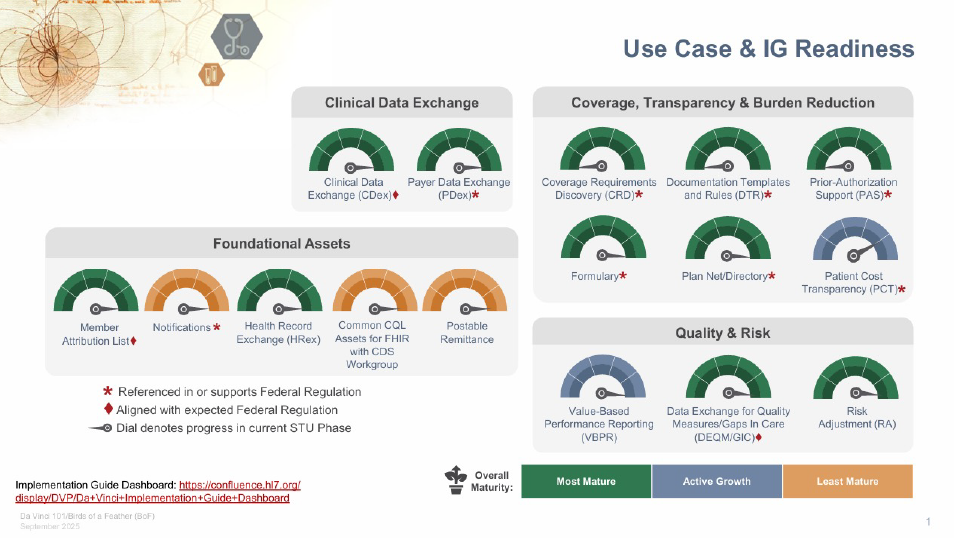
To see the latest updates and information on all of Da Vinci’s use cases, visit our implementation dashboard.
Growing Pilot Participation and Educating the Industry
Since its inception, Da Vinci’s Trebuchet pilot program has helped “launch” payer and provider collaboration of Da Vinci implementation guides into production by collaborating on use-case definitions, problem-solving as a community, sharing knowledge, and organizing pilot work between parties. The Clinical Data Exchange, Payer Data Exchange, and Prior Authorization IGs have been the initial focus, and testing is open to all use cases. Trebuchet organizes cohorts based on the quarter where the pilot work will be completed, and the 2026 pilot cohorts are forming. Sign up now, participate, and gain the shared learnings: Da Vinci Trebuchet FHIR Pilots: Pilot Cohort Sign-up Page
In addition, Patient Cost Transparency Pilotsare creating real-world experiences that will ultimately help patients, working with their clinicians’ guidance, make informed decisions on the course of treatment and the costs of their care. Pilot participants implement the Da Vinci Patient Cost Transparency (PCT) Use Case Implementation Guide, which addresses No Surprises Act requirements outlining a provider’s share of agood faith estimate (GFE) with a payer and that a payer make an Advanced Explanation of Benefits (AEOB) available to a patient in advance of service. Learn more and join the PCT pilot today: Patient Cost Transparency (PCT) Pilot.
Charting a Course for 2026
Based on member feedback, Da Vinci is leaning in to supporting Da Vinci pilots and adoption efforts in 2026 and will continue to strengthen implementer support while fostering community engagement and shared learnings. Da Vinci will continue to collaborate with industry and federal partners, monitoring and responding to opportunities that align with federal rules and related feedback cycles. In addition, the accelerator will heighten awareness of HL7 FHIR APIs and Da Vinci adoption opportunities and success metrics, while continuing to evangelize and provide thought leadership within the community and industry.
The foundation Da Vinci is building collectively not only will help modernize and automate workflows, but it is also critical to enabling an environment for Artificial Intelligence that can leverage legacy systems, maximize investments, and exponentially increase efficiency and care quality.
To learn more about the HL7 Da Vinci Project and to sign up for the listserv, please visit: hl7.me/davincinews.
