


Colombia is taking a decisive step toward nationwide health interoperability through the implementation of a national framework based on HL7® FHIR® Release 4. This initiative, known as the Digital Health Summary (Resumen Digital de Atención en Salud, RDA), enables structured clinical data exchange across thousands of healthcare providers. By doing so, it aims to improve continuity of care for more than 53 million people and position Colombia as a leading example of digital health transformation in Latin America.
Country Context: Interoperability at Scale
Colombia’s healthcare system presents a uniquely compelling environment for interoperability, not only because of its high coverage, exceeding 97% of the population, but also due to its scale, diversity and operational complexity. With more than 9,000 healthcare provider organizations, over 18,000 points of care, and a network of more than 50,000 independent practitioners, the system is both widely distributed and highly heterogeneous.
This landscape is further shaped by an insurance model composed of 28 health plans, with just three organizations covering nearly 45% of the population. In such a context, interoperability must operate reliably across multiple actors, systems and regions.
To better understand the scale, Colombia’s population is approximately 1.3 times that of Canada, twice that of Australia, and about 2.7 times that of countries such as Chile or the Netherlands. This makes Colombia one of the most demanding—and at the same time most representative—settings for implementing interoperability based on global standards.
From Local Integration to Global Standards
For more than two decades, Colombia has developed significant capabilities in electronic data exchange across providers, payers and regulatory agencies. While these mechanisms have supported national operations effectively, they have largely relied on locally defined specifications, limiting scalability and international alignment.
The adoption of HL7 FHIR marks a structural shift in this trajectory. It represents a transition from fragmented, locally defined approaches toward a standards-based ecosystem aligned with international best practices. This shift not only enhances domestic interoperability but also lays the foundation for future cross-border data exchange.
This transformation has been enabled by a strong regulatory framework, including Law 2015 of 2020, which established interoperable electronic health records, as well as subsequent regulations defining core clinical datasets and formalizing the Digital Health Summary (RDA) as the national exchange mechanism.
The RDA: A National Clinical Summary Framework
At the heart of this transformation is the RDA, designed as a structured clinical dataset that captures and summarizes patient care encounters. Its primary goal is to ensure continuity of care by allowing authorized providers to access relevant clinical information generated across different institutions.
Each RDA is implemented using HL7 FHIR, leveraging Composition and Bundle resources to encapsulate clinical content in a standardized and interoperable format. These summaries include patient-reported clinical history, such as conditions, allergies, medications, and family history, as well as structured reports of outpatient visits, emergency encounters and hospitalizations.
This approach not only facilitates information exchange but also establishes a strong foundation for more advanced, patient-centered interoperability models.
A Robust Implementation Guide
The RDA implementation is supported by a comprehensive HL7 FHIR Implementation Guide, publicly available and recognized as one of the most robust in Latin America. Built upon the HL7 Colombia Core, it defines a structured set of resource profiles, extensions and terminologies tailored to the Colombian healthcare system while maintaining alignment with global standards.
This standardization effort has been critical in ensuring consistency across implementations and enabling broad adoption by diverse stakeholders.
Figure 1 – FHIR RDA Implementation Guide
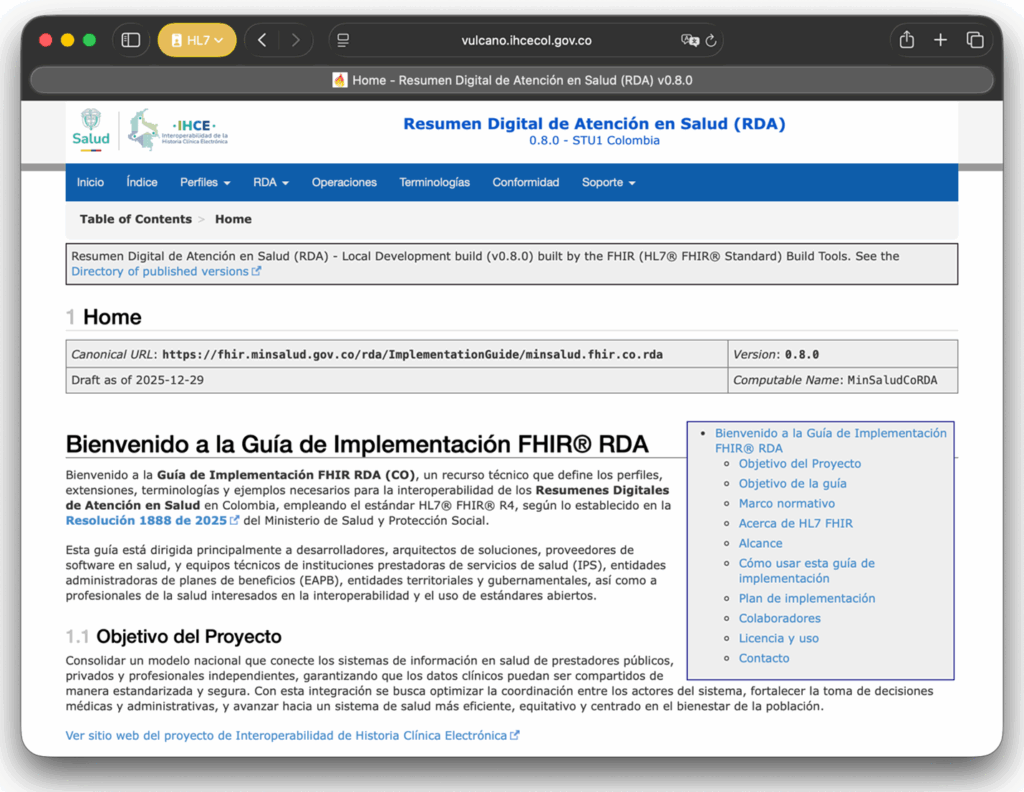
See Colombia’s FHIR RDA Implementation Guide
National Architecture and Technical Capabilities
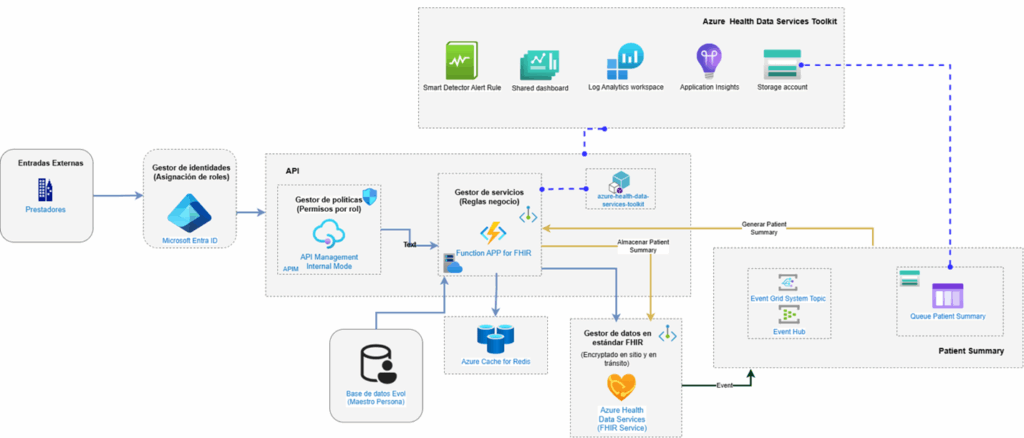
The national interoperability platform is built on Azure Health Data Services and serves as the central infrastructure for clinical data exchange across the country. It integrates with existing Ministry of Health systems and provider information systems, creating a unified interoperability layer.
Key capabilities include patient identity queries, access to provider and organizational registries, and retrieval of clinical summaries generated at different points of care. The platform also enables the construction of a national patient summary, conceptually aligned with the International Patient Summary (IPS), paving the way for future international interoperability.
The system is expected to process approximately 400 million FHIR documents per year, underscoring the initiative’s scale and ambition.
Figure 2 – National Interoperability Architecture
Progress and Nationwide Rollout
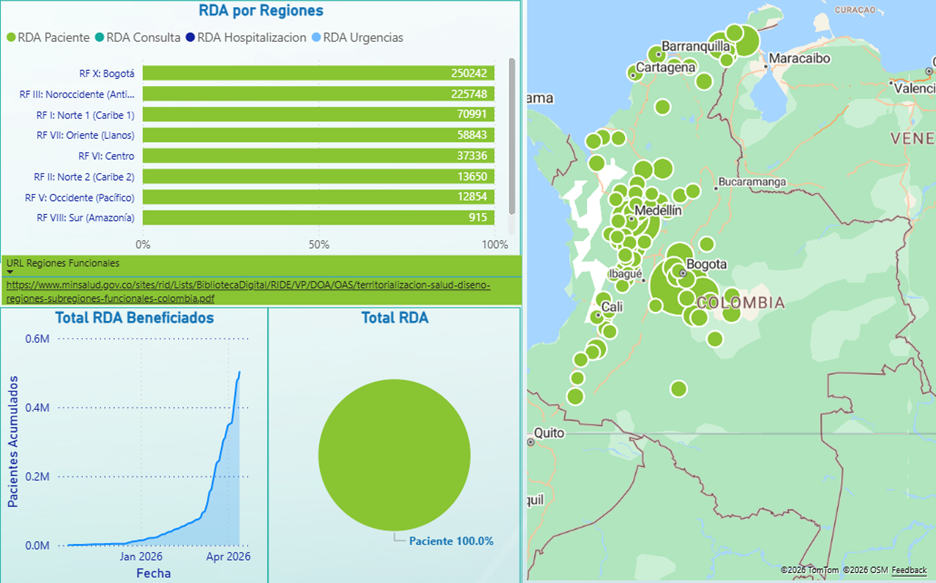
Early results already demonstrate the initiative’s impact. To date, more than 500,000 RDA documents, primarily patient history summaries, have been reported, and over 50 health IT vendors have adapted their systems to support FHIR-based exchange.
A major milestone was reached on April 15, 2026, when the submission and exchange of RDA documents became mandatory nationwide for all healthcare providers, marking the transition from pilot to full-scale implementation.
Figure 3 – RDA Dashboard and National Coverage
HL7’s Role: A Model for Global Collaboration
A key success factor in Colombia’s journey has been the close collaboration between the Ministry of Health, HL7 International, and its national affiliate, HL7 Colombia. This partnership significantly accelerated project execution, with more than 65% of overall progress achieved in less than a year.
HL7 Colombia played a central role in the design of FHIR profiles, the development of the implementation guide, the definition of the system architecture, and direct technical support to implementation teams. HL7 International complemented these efforts by providing strategic guidance and access to global expertise, ensuring alignment with international standards.
Capacity-building initiatives, including government-focused FHIR Camps conducted since 2023, have further strengthened institutional capabilities across multiple public agencies.
This initiative provides a compelling example of how HL7’s affiliate model can effectively support large-scale digital health transformation.
A Growing Ecosystem
The project has been led by the Information and Communications Technology Office of the Ministry of Health and Social Protection and developed entirely by Colombian talent, reflecting the maturity of the country’s digital health ecosystem.
Implementation has involved collaboration with Avvale as the integration partner, Microsoft Azure as the cloud platform provider, and initial funding from the Inter-American Development Bank. In addition, global technology companies such as Google, AWS, Salesforce, and Siemens have supported healthcare organizations in adopting FHIR-based solutions.
Figure 4 – RDA Implementation Team

Building on Prior FHIR Experience
Colombia’s national initiative builds on earlier HL7 FHIR adoption efforts within the country. Organizations such as SURA, Keralty, and Ecopetrol have demonstrated the feasibility and value of FHIR in real-world, large-scale environments.
These experiences provided critical insights and served as foundational references for the design and implementation of the national interoperability framework.
Looking Ahead
The RDA initiative represents the first step in a broader digital transformation roadmap. Future use cases include e-prescribing, modernization of healthcare service reporting, laboratory order and result exchange, and interoperability for financial and administrative processes within the healthcare system.
Conclusion
Colombia’s implementation of the RDA demonstrates that interoperability based on standards such as HL7 FHIR is not only feasible but highly effective, even in complex, large-scale healthcare systems. The initiative strengthens data governance, enhances care continuity, and improves the overall quality of healthcare delivery.
With this achievement, Colombia positions itself as a leading example in Latin America and a relevant case study globally, highlighting the value of collaboration among governments, industry, and organizations such as HL7 in building more connected, efficient, and patient-centered health systems.
Acknowledgments
The authors acknowledge the contributions of Rosemberg Álvarez, Hector Rojas, Dr Hernán Talero, Diego Torres, Edwin Parrado, Ronald Cervera, Samir Ruano, Moises Chica, Camilo Vargas, Diana Galindo, Daniel Pulido, Jonathan Mancilla, Camilo Zamora, Diego Kaminker, Dra Nathalia Ortega, Dr Alonso Verdugo, and the many professionals, institutions, and organizations that have supported the development and implementation of this initiative.

Mario Enrique Cortés