

HL7 Europe explored this question during a session at the Hospitals on FHIR User Days in Pisa, Italy, on 20 October 2026. Bringing together cardiovascular health, freshwater ecology and health informatics, the One Health segment examined how FHIR and shared terminologies can support connections across domains that influence people’s health.
Chaired by Eva Sabajova of HL7 Europe, the session featured contributions from Sónia Serra of the University of Coimbra and OneAquaHealth, and Stratos Kokolakis of HL7 Europe. Cities@Heart and OneAquaHealth provided two complementary European project perspectives, translating a broad interoperability challenge into practical questions for hospitals, developers and the standards community.
Starting With A Person
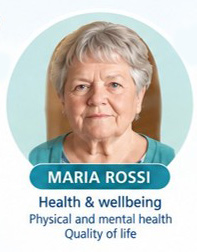
The session’s framing began with Maria, a fictional 72-year-old woman living in Pisa with cardiovascular disease, heart failure and a pacemaker, alongside anxiety and depression. A heatwave forecast shortly after her discharge strongly affects her recovery.
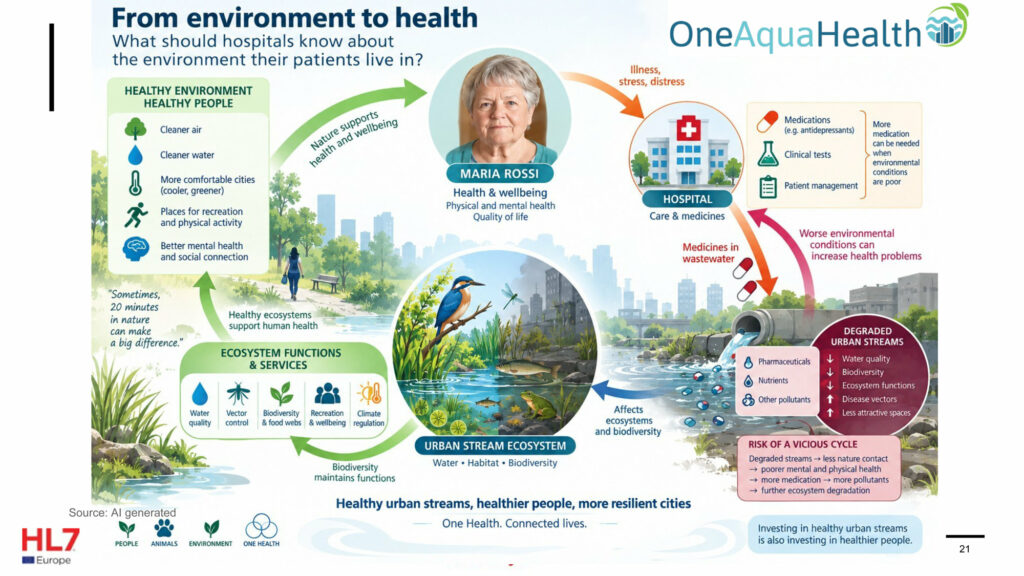
Information relevant to Maria’s wellbeing is fragmented across several systems and organizations. Her hospital holds her clinical history, environmental monitoring systems describe the expected heatwave, and municipal services hold information about neighborhood conditions and available support. Public health teams assess population vulnerability, while Maria and her family understand her circumstances at home. Which information would help Maria and those supporting her make better decisions? Answering needs clarity about the purpose of sharing data with the intended recipient and what the information means.
Two Perspectives on Connected Health
Cities@Heart (2026–2030) is supported by the Innovative Health Initiative Joint Undertaking under Horizon Europe, through Grant Agreement No. 101219389. It addresses cardiovascular disease prevention and management, and health inequalities across seven European cities. Its interoperability work connects healthcare with public health, municipal services and communities, including through FHIR implementation guides and the planned Cities@Heart Accelerator.
OneAquaHealth (2023–2026) is funded by the European Union’s Horizon Europe program under Grant Agreement No. 101086521. It investigates connections between urban freshwater ecosystems and human health and wellbeing, developing environmental monitoring and digital tools using AI. Sónia Serra’s contribution brought the ecological condition of urban streams into the discussion of healthy cities.
Sónia highlighted three requirements for connecting environmental and health information: place, time and meaning. Clinical records describe individuals, while public health statistics may describe populations within defined geographic areas. Environmental records describe stream reaches or catchments. To interpret the information together, you must understand their geographic boundaries, observation periods, and definitions.
From Exchanging Data to Preserving Meaning
The terminology perspective, brought by Stratos Kokolakis, addressed the semantic connections needed between these worlds. FHIR supports structured exchange, but consistent interpretation also depends on terminology bindings, agreed definitions, and sufficient context.
For implementers, this raises concrete modeling questions. An environmental measurement must retain its subject, location, observation time, method, and units. A temperature measured at a monitoring station, for example, cannot automatically be interpreted as an individual patient’s exposure. Representing a measurement through FHIR requires careful decisions about its context and planned use.
FHIR terminology resources supply relevant building blocks: ValueSet defines codes for a particular context, while ConceptMap expresses relationships between concepts. Mappings require validation by domain experts; similar labels do not establish equivalent meaning. Profiles and implementation guides can make these choices explicit and testable.
The session’s central questions therefore spanned beyond selecting a resource or assigning a code. Which existing FHIR resources and terminologies can be reused? Where are mappings or implementation guidance needed? Which challenges deserve priority?
Relevance for the HL7 community
The presentations highlighted both reusable FHIR structures and unresolved terminology questions. Examples included specific codes for environmental indicators and concepts such as catchment and ecological status requiring further terminology work. The closing discussion focused on which resources and terminologies could be reused, where gaps remained, and which challenges should take priority.
For HL7 Europe, connecting these perspectives helps bring standards development closer to implementation needs. One Health use cases offer opportunities to assess existing specifications, identify reusable assets and describe semantic gaps precisely.
The Pisa session placed shared meaning at the center of that exploration. Collaboration between clinical, environmental and urban experts can help the HL7 community translate these questions into implementable approaches that support better decisions for people and communities.
Next Steps
The OneAquaHealth conference in Barcelona on 1–4 November 2026 and the HL7 Europe Working Group Meeting in Málaga on 16–20 November 2026 will offer further opportunities to advance this work. In particular, the HL7 Europe WGM session “Hacking Climate Health” on Monday 16 November 2026, in collaboration with IEEE, aims to highlight the impact of online hackathons as learning and innovation opportunities.
As the OneAquaHealth project approaches completion, its implementation experience offers useful input for initiatives such as Cities@Heart. The planned Cities@Heart Accelerator will bring partners together through hackathons and connectathons to develop and test interoperable solutions for participating city ecosystems.
For more information:
https://hl7europe.eu/hl7-europe-working-group-meeting-malaga-2026/

Eva Sabajova
Chair, HL7 Slovakia