


Gravity Project® is an open, consensus-based Health Level Seven FHIR Accelerator with a mission to develop data standards to address the social determinants of health. As an accelerator, we are led and supported by members who spearhead and shape all our work.
For many years, Gravity Project focused on standards to support the identification of social risks and protective factors (e.g., food insecurity, psychological resilience), including terminology standards and value sets, and an accompanying FHIR Implementation Guide, the Social Determinants of Health Clinical Care IG (SDOH-CC-IG), which supports clinical and community-based closed-loop referrals and social care.
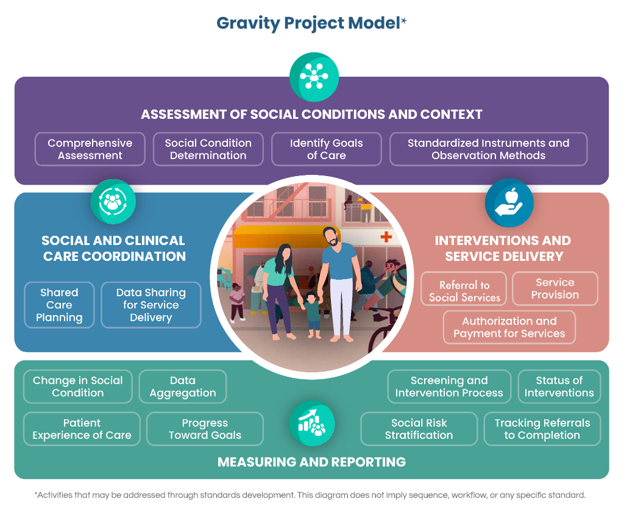
But in 2024, a social care listening series and dual-member discovery efforts asked Gravity to move beyond this model to address national opportunities in standards for payment, reporting, and outcomes. This prompted a revision of our project model (see below). A series of new efforts emerged.
Program Enhancements
Gravity now curates the nation’s value set of core evidence-based, community-based, and social service programs to support documentation of enrollment outcomes (e.g., the Supplemental Nutrition Assistance Program and the Centers for Disease Control and Prevention National Diabetes Prevention Lifestyle Change Program). These concepts can be found in a Value Set Authority Center program value set and referenced in the “Enrolled in Program” observation in the SDOH CC IG.
A national open consensus classification of services to enable interoperable and aggregated directories and organizational service tagging. The classification represents a three-year consensus effort to harmonize the core national service taxonomies: 211 HSIS, findhelp, Unite Us, and Epic, and is currently implemented to facilitate directories and directory mapping nationwide. The concepts will also support the service-type value set in the National Directory for Healthcare Providers and Services.
Service Eligibility Code Taxonomy
This new project will develop standards that support and define eligibility-related concepts. The project has defined the scope of the programs to be addressed- the most common national income-driven programs. It has also defined the areas the project will work to standardize with codeable concepts: standardized methods for identifying likely eligibility for said programs, standards for exchanging likely eligibility, consensus-defined codeable concepts that align with eligibility criteria (e.g., household definitions per program), and codeable concepts for the supplementary materials to support eligibility determination (e.g., pay stubs, utility bills).
Social Care Service Reimbursement
This effort grew directly out of the Payment and Reporting Discovery. The project has three deliverables, all aimed at supporting community and social service reimbursement partnerships with health plan products: a domain analysis model detailing the current state of social and community-based service reimbursement, implementation guidance for claims submission, and a white paper on policy and regulatory efforts. The work will commence in 2027.
These new efforts require expanding the Gravity tent to include new voices. We would love to have you join the collective. Interested entities are welcome to contact me, Gravity Project Program Manager, at sarah.desilvey@med.uvm.edu. Or conversely, you can reach out to the general Gravity Project email at gravityproject@hl7.org.