


The January 1, 2027 compliance deadline for the CMS Interoperability and Prior Authorization Final Rule (CMS-0057-F) is fast approaching, which automates and streamlines prior authorization by requiring impacted payers to implement the Health Level 7 (HL7®) Fast Healthcare Interoperability Resources (FHIR®) Prior Authorization application programming interface (API). This deadline underscores the importance of Da Vinci’s efforts.
Working with Federal Partners and Industry Collaboration
Federal policy continues to affirm the importance of our work advancing HL7 Fast Healthcare Interoperability Resources (FHIR®) and Da Vinci implementation guides to improve data exchange and reduce administrative burden. We continue working with our federal partners, the Centers for Medicare & Medicaid Services (CMS), a member since Da Vinci’s inception, and the Office of the National Coordinator for Health Information Technology (ONC), to align efforts to educate the industry on our standards-based approach and implementation efforts.
As we noted in the summer edition of HL7 News, Da Vinci’s 2026 priorities reinforce the project’s core mission: to develop, pilot, and support adoption of HL7 FHIR implementation guides (IGs) that meaningfully improve payer–provider data exchange and support value-based care across communities.
Throughout the summer and fall, Da Vinci continues to strengthen implementer support, particularly for IGs referenced directly or indirectly in federal regulation, through clearer guidance, shared implementation learnings, and improved feedback mechanisms during development cycles.
Many Da Vinci members and others in industry are actively in production or well on their way. To view progress or find potential testing partners, visit Da Vinci Interactive Implementations to Date.
At the August Community Roundtable, Da Vinci shared “Scaling Health Data Exchange Through Real-World Collaboration,” highlighting how the HL7 Da Vinci Project, The Sequoia Project, and the HL7 FHIR at Scale Task Force (FAST) collaborate to advance practical, scalable healthcare interoperability. The discussion focused on Da Vinci’s implementation guides and use cases, and how collaboration with FAST on identity, security, and authorization and with Sequoia on interoperability and data usability helps move standards from development into real-world implementation.
Check out the recorded video presentation of the August roundtable and others, such as September’s session on the state of electronic prior authorization and October’s discussion with CMS officials and the co-chairs of the Health Tech Ecosystem’s Electronic Prior Authorization subcommittee on its role in accelerating ePA adoption and how Da Vinci’s efforts align.
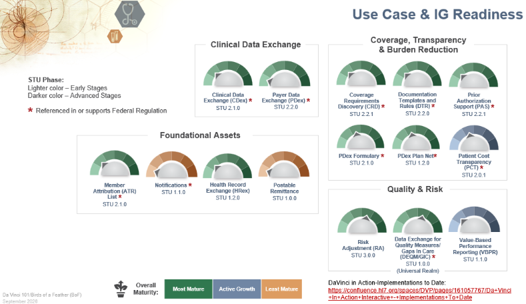
More broadly, Da Vinci members, industry partners, and federal agencies continue to collaborate in 2026 to advance more efficient approaches to data collection and exchange. These partnerships are essential in developing practical, implementable standards that enable more consistent data exchange, reduce administrative burden, and support greater automation across healthcare workflows.
Growing Pilots and Implementer Support
The Da Vinci Trebuchet Pilot Initiative continues to expand, reflecting growing interest in scalable interoperability models, and two new efforts are now making progress:
- The Trebuchet Payer-to-Payer (P2P) Workgroup, launched in March, is actively advancing payer-to-payer exchange by testing direct and networked connectivity approaches. The group is also developing practical guidance on endpoint discovery, data governance, and member consent, all foundational elements for broader exchange.
- Trebuchet Clearinghouse to Clearinghouse Prior Authorization Pilot, launched in April and sponsored by the Cooperative Exchange in collaboration with the HL7 Da Vinci Project, focused on reducing administrative burden by extending prior authorization standards to clearinghouse-to-clearinghouse workflows.
In addition, Patient Cost Transparency (PCT) Pilots are creating real-world experiences that will ultimately help patients, working with their clinicians’ guidance, make informed decisions on the course of treatment and the costs of their care. Participants implement the Da Vinci PCT Use Case Implementation Guide.
These efforts demonstrate how Da Vinci pilots support real-world implementation and inform future standards development. Pilot sessions and implementer support calls provide a forum to work through not only technical conformance, but also workflow redesign, governance, training, operational readiness, and the realities of moving standards-based solutions into production.
Da Vinci also continued engaging with industry partners, and members spoke and attended numerous industry events this year. These gatherings help ensure that the lessons emerging from our technical work, policy discussions, and implementations are shared broadly across the healthcare ecosystem.
Industry learnings also continue to shape our implementation guides, and Da Vinci use cases continue to evolve. Payer Data Exchange (PDex) published a 2.2 STU update related to Provider Access in August, while Risk Adjustment is also planning an STU update which should be published soon.
